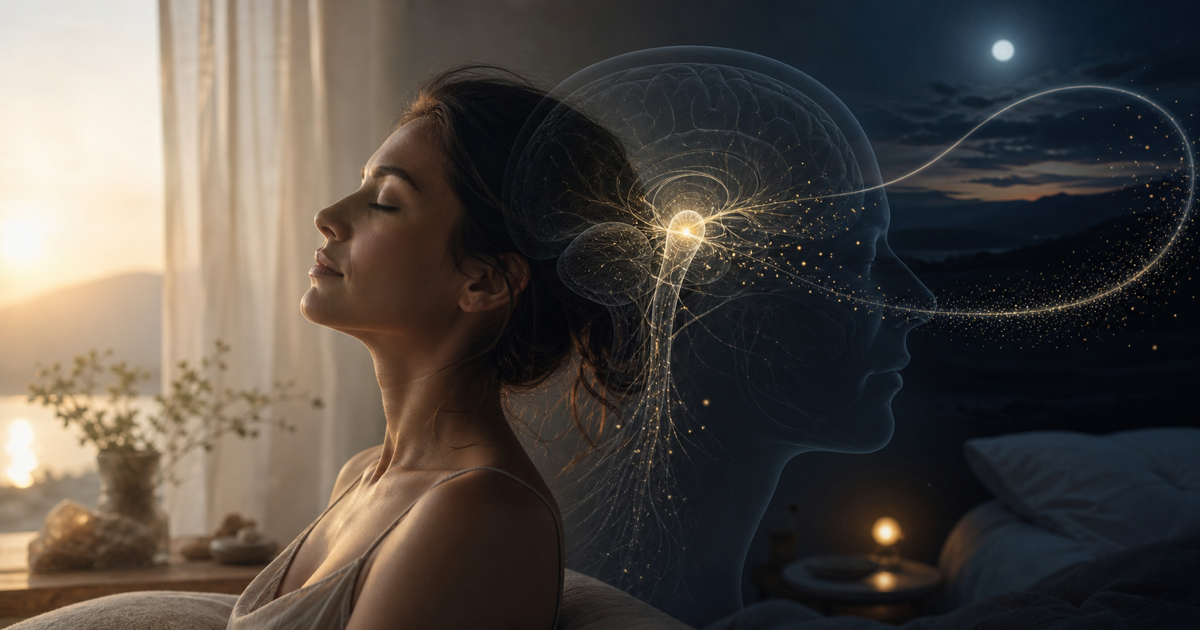
There's a piece of brain tissue about the size of a grain of rice sitting just above where your optic nerves cross. It contains roughly 20,000 neurons. It's called the suprachiasmatic nucleus, or SCN, and it runs your day.
When you feel sharpest. When you crash. When you get hungry. When you can lift the most weight. When your reaction time is fastest. When you fall asleep. When you wake up. The SCN doesn't decide all of this on its own — your behavior, your environment, your meals, and your light exposure all push back on it — but it sets the underlying rhythm everything else dances to.
Most people in modern life live in a partial argument with this clock. The cost of that argument is small if it's occasional and significant if it's chronic. There's a reasonable amount of practical information in the science here that doesn't require you to overhaul your life.
What the SCN actually is
The suprachiasmatic nucleus was identified as the brain's master clock in the early 1970s, after researchers showed that destroying it in animals abolished circadian rhythms. Subsequent work, including studies that won the 2017 Nobel Prize in Physiology or Medicine for Hall, Rosbash, and Young, mapped the molecular machinery: a set of clock genes that turn each other on and off in roughly 24-hour cycles, in nearly every cell of your body.
The SCN's job is to keep all these cellular clocks synchronized. It does this primarily by reading light. Specialized cells in your retina — separate from the cells that handle vision — detect blue-spectrum light and send that signal directly to the SCN. The SCN then sends timing signals to the pineal gland (which controls melatonin), to the adrenal glands (which release cortisol), to the liver, to the gut, to most of your peripheral organs.
That's the clean story. The messier reality is that the SCN is the central conductor, but every tissue has its own internal clock. Your liver runs on a slightly different schedule than your muscle. The gut microbiome has its own rhythm. They all roughly synchronize, with the SCN keeping the beat — but they can fall out of sync with each other if the inputs get scrambled.
This is why jet lag isn't just feeling tired. It's why shift workers have elevated rates of cardiovascular disease, type 2 diabetes, and certain cancers. Sustained desynchronization between the central clock and the peripheral clocks is biologically expensive.
What runs on this clock
Cortisol peaks roughly an hour after you wake. Body temperature follows a daily curve, lowest in the early morning, highest in the late afternoon. Reaction time and coordination peak in the afternoon. Tolerance for high-intensity exercise tends to be highest later in the day for most people. Memory consolidation happens during sleep, on a schedule the SCN sets.
Cognitive performance has its own patterns. Most people show better performance on tasks requiring focused attention and complex problem-solving in the morning, and better performance on tasks requiring creativity and divergent thinking in the late afternoon or evening. This isn't universal, and individual chronotype matters — true morning people and true night owls show somewhat different curves — but the overall pattern is consistent.
The afternoon dip is real. It's not a coffee deficiency. Body temperature drops in the early afternoon, and along with it, alertness and reaction time. This dip exists in cultures with siestas and cultures without. Cultures with siestas just respect it.
The chronotype question
There's a tendency in productivity content to talk about the "optimal schedule" as if it's the same for everyone. The science doesn't support that.
Chronotype — whether you naturally trend earlier or later in the day — has a strong genetic component. Studies of twins put the heritability of chronotype somewhere around 40 to 50%. Variants in clock genes like PER3 and CLOCK shift people meaningfully earlier or later. Age also shifts chronotype: adolescents trend significantly later, older adults trend significantly earlier.
This means the advice you'll see in many places — "wake up at 5 AM, do your hardest work in the morning" — is right for some people and wrong for others. Forcing a late chronotype into an early schedule produces measurable cognitive impairment that doesn't fully resolve with caffeine. Forcing an early chronotype to stay up late does the same.
The useful version of circadian advice is: figure out where your peaks actually are, and then, where your life allows, schedule the work that depends on those peaks accordingly.
What's actually disrupting most people's clocks
A few things tend to push the system out of alignment.
Light exposure is the biggest. The SCN reads blue-spectrum light. Indoor light at night, screens in the hours before bed, and a complete absence of bright light in the morning all blur the signal. Your clock can be set wrong simply because it's getting unclear timing cues.
Meal timing is the second. Eating very late shifts peripheral clocks in the liver and gut, which can drift out of sync with the SCN. The SCN gets its main timing cue from light, but other tissues also use food as a cue. Mismatch between those signals is metabolically costly.
Sleep timing variability is the third. Going to bed and waking at very different times across the week — what researchers call social jet lag — produces measurable health effects similar to actual jet lag. Sleeping in until 10 AM on Saturday and getting up at 6 AM on Monday is biologically equivalent to flying through several time zones twice a week.
Caffeine and alcohol both disrupt sleep architecture in ways that affect the next day's rhythm.
Shift work, of course, is the most extreme version of all of this.
What works without overhauling your life
A few changes have decent evidence and don't require major lifestyle changes.
Get bright light early. The single most reliable way to anchor your clock is bright light exposure within the first hour of waking. Outside is best — even a cloudy day delivers more lux than indoor light. Ten to twenty minutes outside in the morning is enough to noticeably stabilize the rhythm for most people.
Dim the evening. You don't need to abandon screens. You can lower the brightness, switch to warmer color temperatures, and keep room lighting low for the hour or two before sleep. The strict "no screens after 9" rule is harder to sustain than just dimming everything.
Keep wake time consistent. This matters more than bedtime. The clock anchors more firmly to the time you wake up than the time you fall asleep. If you have to choose one variable to keep stable, choose wake time.
Eat in a consistent window. Even if you're not doing intermittent fasting, having most of your calories in roughly the same daily window — say, a 10 to 12 hour eating window — helps keep peripheral clocks aligned.
Schedule around your actual peaks. Notice when you're sharp and when you crash, for two weeks. Then, where your life allows, do focused work in your peak windows and put admin, calls, and lower-stakes activity in your dips.
Don't fight your chronotype if you can avoid it. If you're a natural night owl, working a job that requires 6 AM productivity will produce decades of low-grade cost. If you can shift your schedule, even partially, the gains are large.
The reframe
The framing of "optimization" gets oversold in this area. The honest version is more useful.
Your body runs on a clock that's roughly 24 hours, that gets its timing from light and meals and sleep, and that has been doing this for as long as multicellular life has existed. Modern environments — indoor light, late screens, flexible meal times, social schedules that override biology — push back on that clock harder than any environment in human history.
You don't have to live like a monk. You don't have to wake up at 4 AM. You don't have to eat in a four-hour window.
You do have to give the clock enough clear signals to do its job. Bright morning light. A reasonably consistent schedule. An eating window that doesn't sprawl. A sleep window that's mostly stable.
That's a small list. The dividends of doing it are not small. They show up in mood, attention, energy, metabolic health, and over the long run, the rate at which your brain ages.
Twenty thousand neurons are trying to run your day. Helping them is mostly about not getting in the way.
Pairs well with: "What People Over 90 Actually Do" and "Fasting vs Caloric Restriction vs Keto."