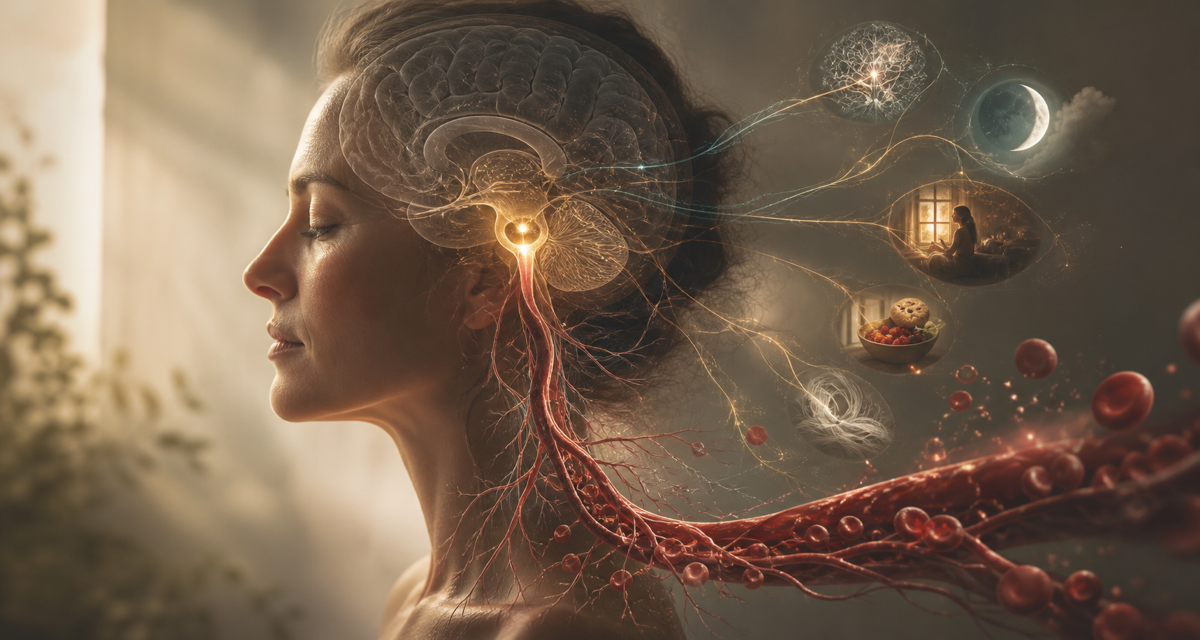
You crash at 3pm. Not tired-tired, just suddenly unable to hold a thought together, reaching for something sweet before you've decided to. You lie awake Sunday night for no reason you can name. Your heart starts racing before your mind has caught up to what's stressing you out. Most people file these under personality — I'm just someone who needs a nap, I'm just a stress case — and move on.
There's a small, almond-sized structure at the base of the brain that's actually running most of this. It's called the hypothalamus, and it governs hunger, sleepiness, alertness, cravings, ovulation, fight-or-flight, wound healing, immune response. Almost nobody thinks about it. It doesn't show up in casual brain talk the way the amygdala or prefrontal cortex do, even though it's doing more of the minute-to-minute work than either.
This is the first post in a series on the hypothalamus and the daily hormone rhythms — the biorhythms — it runs. I want to start with what makes this structure different from the rest of the brain, because that difference explains a lot of what gets misread as a personal failing.
The mechanism: a bridge, not just a switchboard
Most of the brain works by neurons firing at other neurons, a closed electrical conversation happening inside the skull. The hypothalamus does something the rest of the brain can't do: it talks directly to the bloodstream, in both directions. It releases hormones into the blood, and it reads hormone levels out of the blood, adjusting its own output based on what it finds (Saper & Lowell, 2014). It's less a switchboard and more a bridge — the interface between the nervous system and the endocrine, or hormone, system.
Hormones are chemical messengers that coordinate cells that aren't wired to each other directly. They're slower than the neurotransmitters neurons use to fire off quick electrical signals, but they do something neurotransmitters can't: they can make a neuron more or less likely to fire, and over time, they can change a neuron's structure (McEwen, 2007). And because hormones travel through blood instead of along a wire, the hypothalamus can use them to reach every organ in the body at once. No other part of the brain has that reach.
Here's what's actually happening when your body seems to act before you do: the hypothalamus doesn't work alone. It runs through feedback loops — hypothalamus to pituitary gland to a target gland elsewhere in the body, and back again. The pattern repeats across systems. The hypothalamus releases a "releasing hormone," which travels a short distance to the pituitary. The pituitary responds by releasing its own hormone into the blood. That reaches a target gland — the adrenals, the thyroid, the ovaries or testes. The target gland releases the hormone that actually does the work. And once that hormone's level gets high enough, it signals back to the hypothalamus to ease off. Self-regulating, closed-loop, mostly running without you.
Take the HPA axis — hypothalamus, pituitary, adrenal — the loop behind the stress response. The hypothalamus releases CRH. The pituitary responds with ACTH. ACTH tells the adrenal glands to release cortisol, the body's main stress hormone. Cortisol's reach is systemic: it raises blood sugar, sharpens attention and memory, suppresses immune function, raises blood pressure, dampens pain, and over time decreases serotonin signaling — part of why prolonged stress can flatten mood. Useful if something is actually chasing you. Less useful when the "threat" is an inbox or a hard conversation that's been unresolved for three months. The system can't tell the difference between a predator and a long-running low-grade stressor. It just runs the same loop either way.
The HPG axis — hypothalamus, pituitary, gonad — runs the same way for reproductive hormones. GnRH from the hypothalamus, LH and FSH from the pituitary, testosterone or estrogen and progesterone from the gonads. And this loop has a detail worth sitting with: it doesn't run on a flat baseline. In healthy adult men, testosterone follows a daily pattern, highest around 8am and lowest around 8pm (Bremner et al., 1983). The body isn't producing a steady drip of hormone all day. It's running on a clock.
This isn't a willpower problem
The behaviors this system runs are mostly invisible to conscious thought. You don't decide to feel hungry. You don't decide to wake at 3am with your heart pounding. You don't decide to get sleepy after a heavy lunch. Conscious processing happens in the cortex, the brain's outer layer, the part that plans and reasons and feels like "you." Hormone-driven behavior happens on an older circuit underneath it, one that was running long before there was a cortex to argue with it.
That doesn't mean the conscious mind has no say. Meditation lowers cortisol output over time (Pascoe et al., 2017) — a measurable effect, not a placebo story. But that's influence, not override. You can shift the conditions the system operates under. You can't out-argue it in the moment. The 3pm crash isn't a discipline gap. It's a hormonal system doing exactly what it evolved to do, sometimes under conditions — irregular sleep, a stimulant-heavy morning, a stressor that never resolves — it wasn't built for.
Where this shows up in daily life
Once you know the hypothalamus is reading and writing to the blood in real time, a lot of daily experience reads differently. The stress that lands in your chest before you've consciously registered the bad news isn't your mind being dramatic — it's cortisol already circulating. The 3pm craving for something sugary isn't a lack of resolve — it's a hormonal dip the system is trying to correct. The inability to fall asleep after a stressful day isn't insomnia as a character flaw — it's a loop that hasn't gotten the signal to stand down yet.
None of this makes the system unmanageable. It makes it legible. The hypothalamus responds to inputs — light, food timing, sleep timing, chronic stress load — and those inputs are things you actually have some access to, even if you don't have direct access to the hormone loops themselves.
What helps
- Notice the pattern before you label it a personality trait. If the 3pm crash or the Sunday-night wakefulness happens on a schedule, that regularity is itself information — a clock-driven system, not a mood.
- Give the stress loop something to close on. Cortisol's loop is built to spike and then resolve. A stressor that never gets processed — through action, conversation, or even a deliberate wind-down — keeps the loop open longer than it was designed to run.
- Treat meditation and similar practices as calibration tools, not fixes. The research on cortisol reduction is about steady practice changing output over time, not a single session solving an in-the-moment spike.
- Pay attention to timing, not just content. Hormones like testosterone follow daily patterns. What you eat, when you sleep, and when you're active interacts with a system that already has its own clock running underneath your schedule.
- Hold the anatomy loosely and the pattern tightly. You don't need to memorize CRH or ACTH to use this. The pattern that matters is: brain signals gland, gland signals gland, hormone does the work, feedback closes the loop.
The reframe
The hypothalamus is easy to overlook because it doesn't feel like thinking. It doesn't generate the sensation of a decision being made. But it's running a constant, two-way conversation with the bloodstream that shapes hunger, sleep, stress, and mood long before the cortex weighs in. What looks like a mood swing or a lapse in discipline is often just this system, doing its job, under conditions it wasn't designed for.
The rest of this series follows that thread — melatonin, cortisol, and the daily rhythms this bridge keeps running whether you're paying attention to it or not. The bridge was there the whole time.