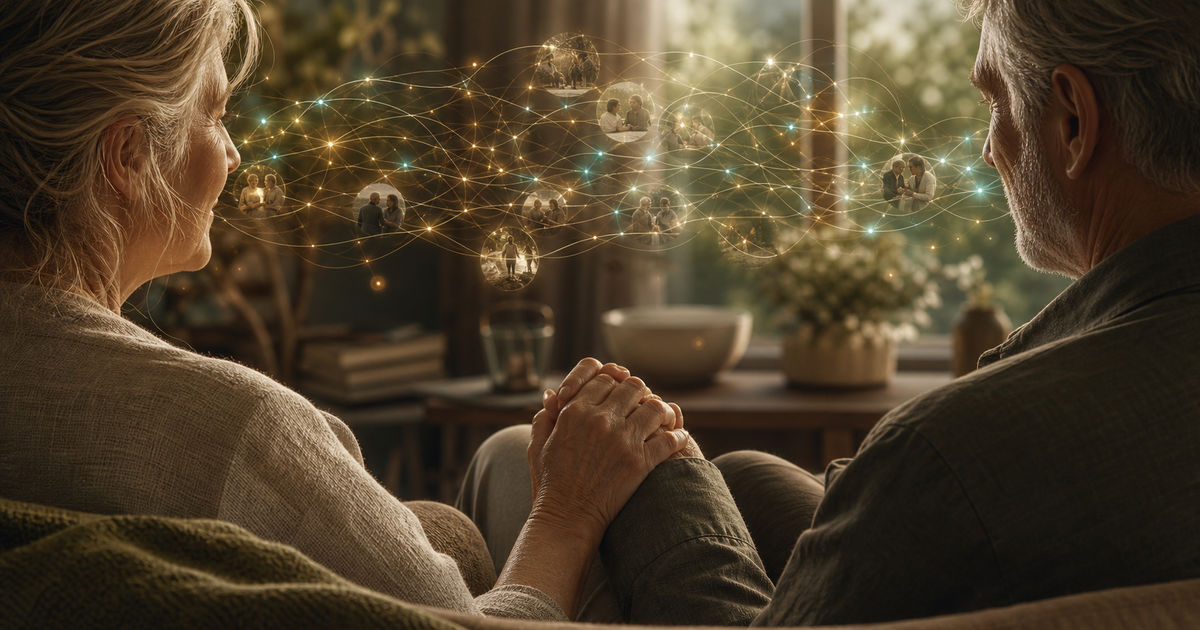
There's a particular kind of conversation that long-married couples have. One person starts a sentence and the other one finishes it. They reference an inside joke from twenty years ago in three words. They communicate full thoughts with a glance across a dinner table. From the outside, it looks like telepathy. From the inside, the people doing it can't always explain how it works.
Over the last fifteen years, neuroscience has gotten good enough at scanning multiple people simultaneously that we can actually look at what's happening in those brains during those moments. The findings are interesting and worth taking seriously without overstating them. The short version: long-married couples whose relationships are working show measurable neural synchronization that single brains don't show, and that newer couples don't show as strongly. The longer version is what the rest of this post is about.
I want to be careful with this material because it's the kind of finding that can get oversold. There are good replications and there's also a fair amount of media coverage that's run ahead of the science. I'll try to keep the line between them visible.
What hyperscanning is and what it can show
Most fMRI studies look at one brain at a time. The technical term for scanning two or more brains at once is hyperscanning. The technique was first developed in the early 2000s by researchers including Read Montague and has been applied increasingly to social interaction over the last fifteen years.
The idea is that you scan two people while they're doing something together — talking, cooperating, listening to the same story, watching the same scene — and then look for whether their brain activity is correlated. If two brains show patterns of activity that move together in time, in regions involved in attention or social processing or emotion, you can quantify how strongly they're synchronizing.
This is different from saying the brains are doing the same thing for the same reason. Synchrony just means the patterns are tracking each other. The interpretation of what that means is more complicated than the measurement.
In healthy adults, several conditions reliably produce neural synchrony. Listening to the same story produces synchrony in language regions. Watching the same emotional scene produces synchrony in regions involved in emotional processing. Cooperating on a task produces synchrony in regions involved in goal pursuit. Eye contact produces synchrony in social-attention regions. These findings are well-replicated.
The interesting question for relationships is whether some pairs synchronize more than others, and whether that variation tracks with anything meaningful about the relationship.
What the couples studies have found
Several research groups have looked at this. Darby Saxbe and her collaborators have done particularly careful work on couples and physiological synchrony. Uri Hasson's lab at Princeton has done foundational work on speaker-listener neural coupling. Thalia Wheatley at Dartmouth has studied friendship-based synchrony. Each of these groups has approached the question slightly differently.
A few patterns have emerged with reasonable consistency.
Couples in functioning relationships show stronger neural synchrony during shared tasks than strangers do. The effect is most clearly observed in regions associated with social attention, emotional processing, and prediction.
The strength of the synchrony correlates, modestly, with relationship satisfaction. Couples who report higher satisfaction tend to show more synchrony in some studies, though the relationship isn't perfectly clean and the effect sizes are not enormous.
Speaker-listener synchrony — the degree to which a listener's brain comes to mirror the speaker's brain during conversation — is associated with how well the listener actually understood and remembered what the speaker said. Couples who communicate well tend to show more of this kind of synchrony than couples who don't.
Physiological synchrony — heart rate, breathing, skin conductance — also tracks with relationship measures. Long-married couples often show synchronized physiology even at rest, and the degree of synchrony correlates with self-reported closeness.
The patterns are real and they're measurable. They're also subtler than the popular framing suggests.
What this isn't
A few things to clear up before going further.
This isn't telepathy. The synchrony is a statistical relationship between brain activity patterns, not a direct sharing of thoughts. Two people watching the same movie show synchronized brain activity in visual cortex, but neither one knows what the other is seeing.
This isn't a soulmate finding. There's no evidence that synchrony picks out couples who were "meant to be." What it tracks is functioning shared attention and shared experience, which can build between people who chose each other relatively arbitrarily.
This also isn't an instruction. The synchrony is downstream of the relationship working, not the cause of it. You can't make yourself synchronize with someone by trying. The synchrony is the byproduct of having actually paid attention to each other across time.
And the effect sizes are modest. The differences between high-functioning couples and strangers are real and statistically meaningful, but they're not at the level of "totally different brains." They're at the level of "noticeably more correlated activity in specific regions during specific kinds of shared experience."
Why long couples synchronize at all
The mechanism story goes something like this.
Brains are prediction machines. When you're talking to someone, your brain is constantly predicting what they're going to say next, what they mean, what they're feeling. When you're predicting accurately, you're effectively running a model of the other person's mental state in your own brain.
Over time, with someone you talk to a lot, those predictions get better. You learn how they think, what topics they care about, what their reactions are likely to be. The predictive model gets richer and faster. By the time you've been with someone for twenty years, your brain has built a fairly accurate ongoing model of theirs.
When you're together, that model is being constantly updated and run. It's running on real-time signals — their voice, expression, breathing, the way they're moving — and producing predictions that are usually right. The synchrony measured by hyperscanning is partly the measurable output of that model being well-fitted.
This explains why the effect grows with time and with quality of attention. The brain has to actually be paying attention to build the model. Couples who've been together for thirty years but haven't really listened to each other in twenty don't show the same synchrony as couples who've been together fifteen and stayed engaged.
What this changes about how to think about long relationships
A few things follow from this research, both about how long relationships work and about what it takes to build them.
Attention compounds. Each conversation, each shared experience, each moment of actually listening adds data to the model your brain is building of your partner. Over years, this accumulates into something specific and irreplaceable. The synchrony you can measure in long couples is partly the cumulative product of that attention.
Interruption damages the model. Periods of bad attention — distraction, disengagement, parallel lives — slow the model's update rate. The model still exists but it stops tracking the actual person. This is one of the mechanisms behind the experience of "feeling like strangers" after years together. The model is out of date.
Repair is biological work. Coming back from disconnection isn't just emotional reconciliation. It's the brain re-learning the partner from current data. That takes time, attention, and shared experience. Couples in repair often report that they need to feel like they're "rebuilding" something. They are. The model is being updated.
Synchrony isn't the goal — connection is. The synchrony is a marker, not a target. Couples who try to maximize their measured synchrony aren't doing what working couples are doing. Working couples are paying attention to each other, doing things together, having real conversations, fighting and repairing — and the synchrony emerges as a byproduct.
The asymmetry of speaking and listening matters. Hasson's work has shown that listening that produces brain alignment is hard work. It's not passive. The listener's brain has to actively model what the speaker is saying. This is why distracted listening doesn't produce synchrony, even if you're physically present. The model isn't getting fed.
What this looks like in long-married couples that work
Studies of couples who've stayed satisfied across long marriages — Gottman's research is the largest body of this — converge on a few patterns. Engaged listening. Repair after conflict. Shared experiences that keep both people learning about each other. Attention to small bids for connection. Time spent in conversation that isn't just logistics.
The neural synchrony research adds a layer of explanation underneath those patterns. Those behaviors aren't just nice things to do. They're the inputs that build and maintain a deep predictive model of another person's mind. The model is what produces the experience long-married couples describe — the sense of being known, the conversations that don't need full sentences, the ease that doesn't have to be performed.
You don't get the model without the inputs. The inputs are what relationships actually consist of, accumulated over time.
Where this leaves us
The neural synchrony work is interesting and the basic findings are robust. The popular framing — "couples in love sync their brainwaves!" — overstates what the research has shown. The careful version is something more like: long, attentive, mutually engaged relationships produce measurable changes in how partners' brains track each other during shared experience, and these changes are mechanistically related to the kind of functioning relationships people actually want.
The work doesn't tell you who to marry. It doesn't predict relationship success in any clinically useful way. What it does tell you is that the things long marriages are made of — attention, shared experience, listening, repair — leave a mark on the underlying biology, and that mark is part of why those relationships feel different from any other relationship in your life.
Build the model. Keep updating it. The synchrony comes along for the ride.
Pairs well with: "What Fun Together Actually Does to Your Brain" and "Reliable Friends Are Brain Health."