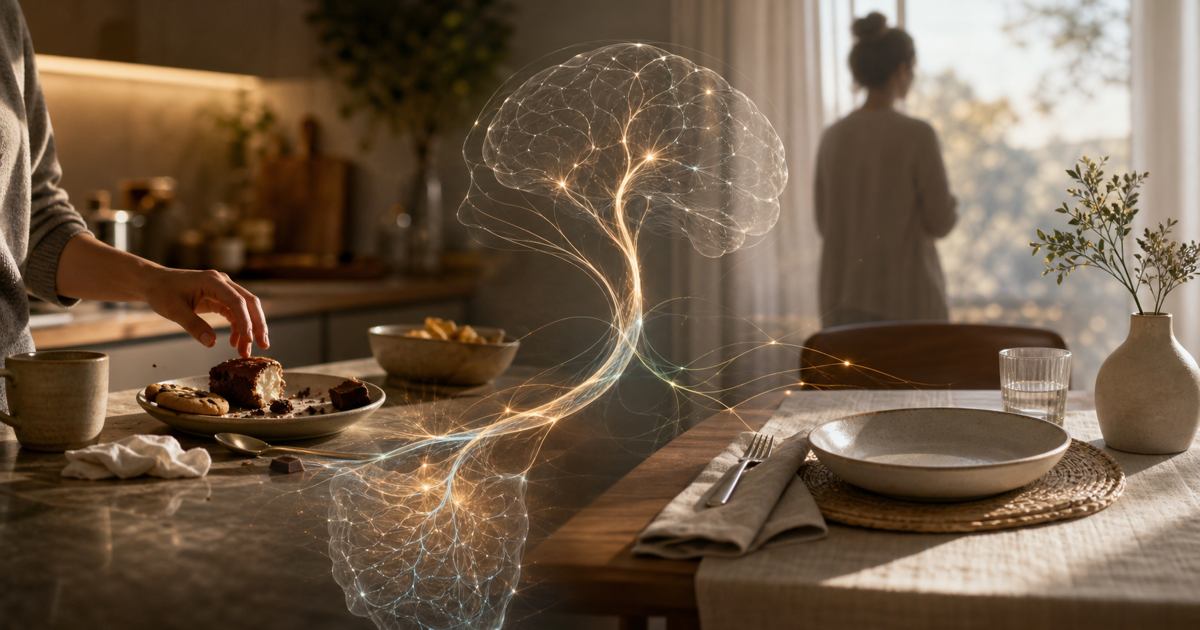
Two people get the same bad news at work.
One of them is in the kitchen within twenty minutes, eating something they didn't plan to eat, not particularly hungry, but unable to stop.
The other one forgets to eat dinner.
Same stressor. Opposite response. Both reactions are real, neither is moral failure, and the explanation has more to do with a hormone called neuropeptide Y than with willpower.
I want to be careful here. There's a version of this conversation that turns into "your genes made you do it, so don't worry about it" — and that's not true and not helpful. There's also a version that turns into "this is just stress, push through" — and that's not true either. The real picture is more useful than both.
What stress actually does to appetite
When you encounter a stressor, your body runs a fast cascade. The hypothalamic-pituitary-adrenal axis activates. Cortisol rises. Adrenaline rises. Blood gets routed to muscles. Digestion slows.
In the very short term, stress generally suppresses appetite. That's the "I forgot to eat lunch because I was in back-to-back meetings" experience. Acute stress, less hunger.
But sustained stress — the kind that runs for hours or days — does something different. Cortisol stays elevated. And cortisol over time increases appetite, particularly for high-calorie, high-fat, high-sugar food. This isn't speculation; it's been measured directly. Studies that infuse cortisol into healthy volunteers reliably produce increased appetite within hours.
So the first thing to know is that "stress eating" usually isn't the response to acute stress. It's the response to chronic stress. The job that's been bad for six months. The relationship that's been rough for a year. The deadline that won't end.
That distinction matters. Different problem, different solution.
Where neuropeptide Y comes in
Neuropeptide Y, or NPY, is a small protein your brain produces in large quantities. It does two things relevant here.
First, it's one of the most powerful appetite-stimulating signals in the brain. NPY released in the hypothalamus drives hunger, especially for carbohydrate-rich food.
Second, NPY acts as a stress buffer. It dampens the activity of the amygdala — the brain's alarm system — and helps your nervous system return to baseline after stress. People with higher NPY signaling tend to be more resilient under pressure. Studies of soldiers in extreme training environments have found that those who maintain higher NPY levels handle the stress better psychologically.
Here's the wrinkle. There's genetic variation in how much NPY individuals produce. People with certain variants of the NPY gene — including a well-studied promoter variant — produce less NPY in response to stress.
For those people, two things happen at once when chronic stress hits. They have less of the buffering hormone that calms the stress response. And they have less of the hormone that, paradoxically, also drives hunger.
The way that combination plays out is individual. Some people with low-NPY variants tend to under-eat under stress (less appetite signal, plus heightened anxiety that suppresses food intake). Some end up eating more, because the unbuffered cortisol response drives food-seeking. The science here is more complicated than a simple "low NPY = stress eater" story.
What is clear: people genuinely respond differently to the same stress, and a meaningful chunk of that variation is biological.
Ghrelin, dopamine, and the comfort food loop
NPY isn't the only player. Ghrelin, the so-called hunger hormone, also rises with chronic stress. And the foods we tend to reach for under stress — sugar, fat, refined carbohydrate — trigger dopamine release in the reward system.
That dopamine response is real and fast. Stress goes up, comfort food goes in, dopamine spikes, distress drops temporarily. Your brain learns that pattern within a few repetitions.
This is the part that makes stress eating sticky. It's not that people who stress eat lack character. It's that they have a working dopamine system, and that system is doing exactly what it evolved to do — reinforce behaviors that reduce immediate discomfort.
The behavior gets locked in long before anyone makes a conscious decision about it.
What this is not
Two things to clear up.
This isn't a free pass. Genetics shape your response curve, but they don't determine the outcome. People with low-NPY variants can develop healthy stress responses with the right environment and skills. People with high-NPY variants can develop disordered eating with the wrong ones. Biology loads the dice. It doesn't roll them for you.
This also isn't a willpower argument in disguise. If you've spent years trying to white-knuckle your way out of stress eating and it hasn't worked, that's not because you didn't try hard enough. It's because willpower targets the conscious end of a process that's mostly running underneath conscious access.
The interventions that actually work target the underlying system, not the surface behavior.
What actually helps
A few things have decent evidence.
Address the chronic stress, not the eating. This is the unglamorous answer. The behavior is downstream of the stress signal. As long as the stress signal stays high, the behavior is hard to change. That's why stress-eating advice that ignores the source of the stress almost never sticks.
Sleep. Six or fewer hours a night raises cortisol, raises ghrelin, lowers leptin (the satiety signal), and pushes appetite toward exactly the foods involved in stress eating. The single most reliable lever for changing your stress-eating pattern is probably more sleep, not better food choices.
Regular movement, not exercise as punishment. Physical activity raises NPY, lowers cortisol over time, and improves stress resilience. The studies showing this don't use intense workouts. They use regular, sustained, moderate activity.
Protein and fiber at meals. Both blunt the cortisol-driven appetite signal and the ghrelin response. This is small but reliable.
Notice the pattern, but don't moralize it. The internal monologue around stress eating is often more harmful than the eating itself. The shame loop — eat, feel bad, stress more, eat — is the actual mechanism that keeps the behavior locked in. People who notice the pattern with curiosity rather than self-criticism break it faster.
If it's significant, get real help. Disordered eating responds well to treatment. If you suspect what you're dealing with is more than the occasional stress snack — if it's affecting your health, your relationships, your sense of self — that's worth addressing with a clinician. Not as a moral failing. As a thing that has actual treatments.
The reframe
Your appetite under stress is not a character test you're failing. It's an output of a system that's doing what it evolved to do. That system can be supported, slowly, by changing the inputs — sleep, movement, the actual stressor itself, and the way you talk to yourself about all of it.
You don't have to win against your biology. You have to give it conditions where it doesn't have to work so hard.
If you're struggling with disordered eating patterns, the National Alliance for Eating Disorders helpline (1-866-662-1235) offers confidential support and referrals.